Register
 Login
Login Register




RBA February Meeting: One Move or a Policy Reset?

Hebe Chen >
Senior Market Analyst
Hebe Chen >
Senior Market Analyst
 Updated Fri, 2026 January 30 02:09

Only months ago, a February rate hike by the Reserve Bank of Australia felt like a distant possibility. Today, markets are treating it as a base case–with roughly 70% odds priced in. The shift has been swift — and revealing.
Rate hike, again?
Not long ago, the market conversation was still about rate cuts. Growth risks were front of mind, inflation appeared to be easing, and the policy debate was turning more cautious. But as the first RBA meeting of 2026 approaches, that narrative has flipped.
The trigger was data — and the story it told.
Australia’s December CPI surprised on the upside, rising 3.8% year-on-year after 3.4% previously. At the same time, the labour market refused to cool. Unemployment fell to 4.1%, reinforcing the message that demand remains firm and the economy is still absorbing higher rates better than expected.
Put simply, inflation is proving more persistent — and the economy more resilient — than policymakers had anticipated.
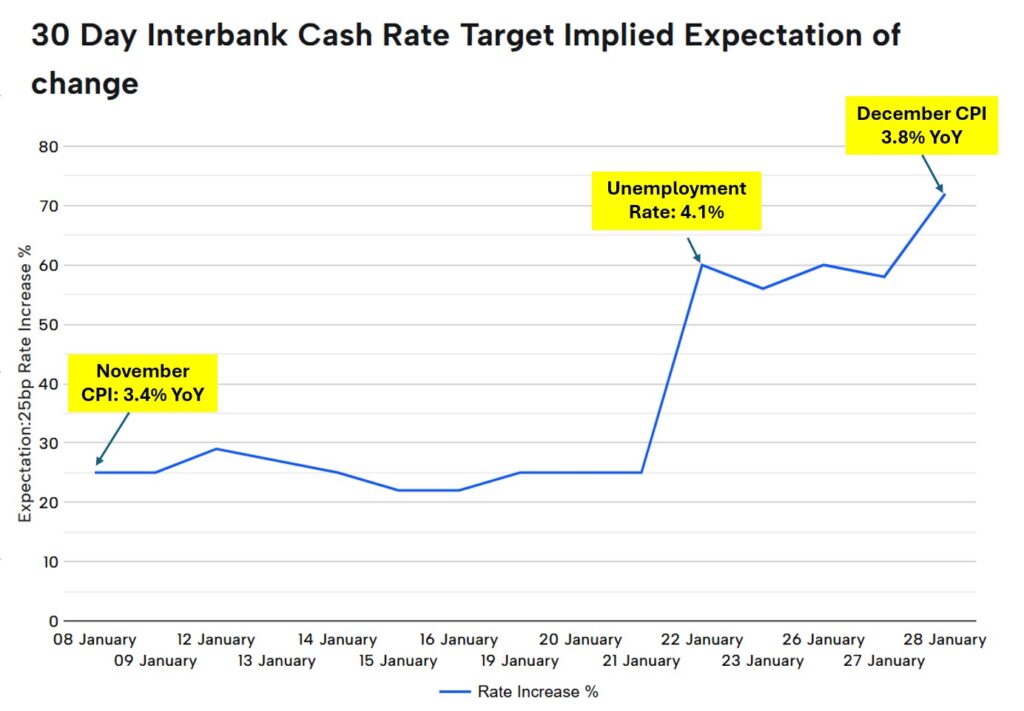
Source: ASX
Markets are looking beyond February
What’s more, markets are not just pricing a February move. They are increasingly leaning toward further tightening ahead.
Interest-rate futures now imply two to three additional hikes before year-end. If that path plays out, Australia’s cash rate would move back above 4%, effectively returning to levels seen at the start of 2025.
That tells us something important. The market is no longer debating whether policy is restrictive enough. It is questioning whether interest rates need to stay higher for longer — or go higher still — to match today’s inflation risks.
In that sense, the February meeting may be less about a single decision and more about whether the RBA is committing to re-enter a rate-hike cycle — one Australia has already lived through not long ago, and one households and businesses are beginning to feel fatigued by.
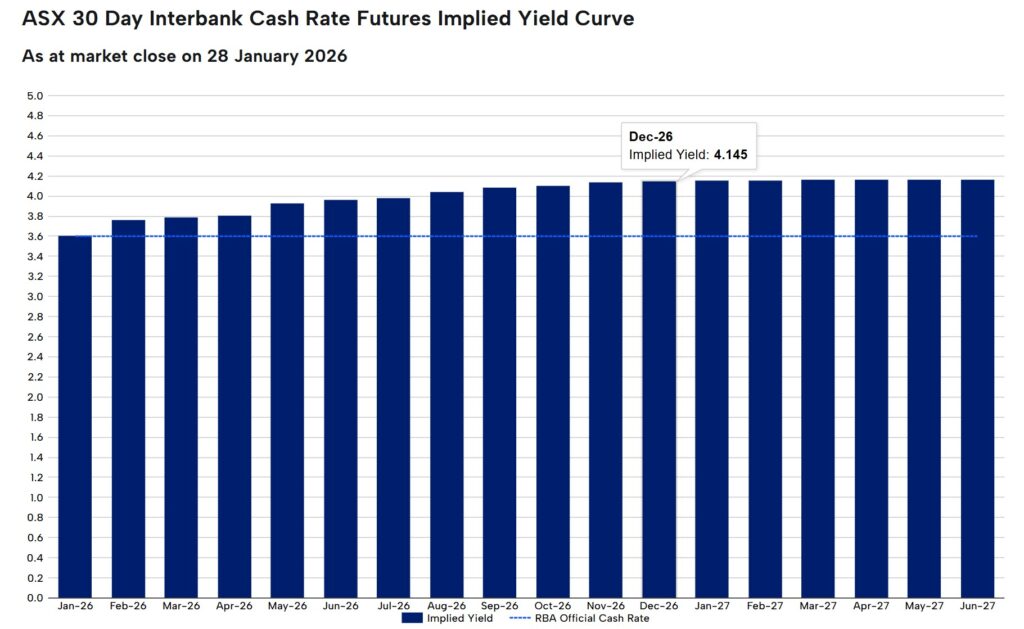
Source: ASX
Why is Australia back here?
That picture is uncomfortable for the RBA.
For a central bank that has spent the past year emphasising “data dependence,” the latest numbers challenge the assumption that inflation is safely on a glide path back to target. But beyond the data itself sits a deeper issue — and one that is talked about far less.
Despite being among the last major central banks to cut rates, and despite its reputation for caution, Australia is once again facing renewed inflation pressure. That raises a harder question: what has been misjudged?
Rate hikes are the most direct response to inflation risk. But they do not explain the full picture. A growing gap appears to be opening between policy projections and economic reality.
The RBA’s most recent forecasts underestimated both sides of the equation. Inflation has come in hotter than expected (3.8% vs 3.3%), while the labour market has remained far more resilient (4.1% vs 4.4%). That combination points to a meaningful mis-projection — not just of inflation dynamics, but of underlying demand strength across the economy.
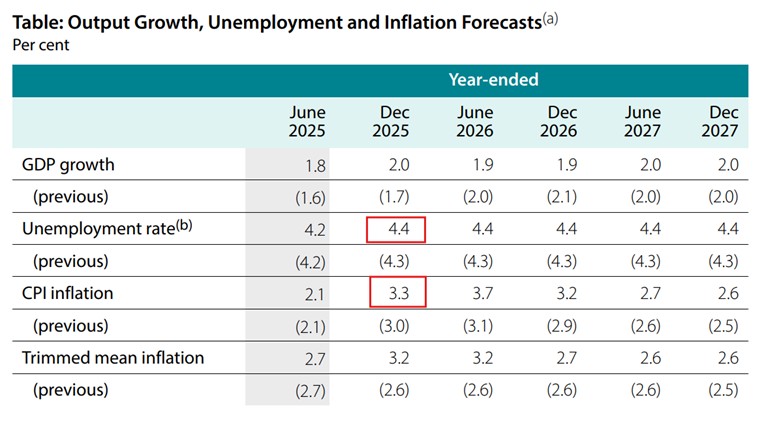
Source: RBA November Statement
When those forces are underestimated, policy risks becoming reactive rather than pre-emptive — and the cost of catching up is always high.
What’s next?
The real question is not whether the RBA should raise rates again — markets have largely answered that. The risk now lies in policy fatigue and in correctly diagnosing the underlying drivers of inflation. Australian households and businesses have already lived through this cycle once, and tolerance for prolonged tightening is thinner than before.
For the RBA, the challenge in a tightening cycle 2.0 is not simply keeping rates “higher for longer,” but using this second chance to better understand the true sources of inflation — and, just as importantly, to restore confidence in the policy path itself. February may not deliver all the answers, but it will reveal how the central bank intends to regain control of the narrative, not just the interest rate.
There is also a market dimension that goes beyond interest rates themselves. The Australian dollar has already pushed toward three-year highs before the February meeting. If rates are expected to stay higher for longer, tighter financial conditions — via a stronger currency and higher funding costs — risk slowing growth without materially easing inflation, raising stagflation risks the RBA will be keen to avoid.
Disclaimer: The material provided here has not been prepared in accordance with legal requirements designed to promote the independence of investment research and as such is considered to be a marketing communication. Whilst it is not subject to any prohibition on dealing ahead of the dissemination of investment research we will not seek to take any advantage before providing it to our client. No representation or warranty is given as to the accuracy or completeness of this information and therefore it shouldn’t be relied upon as such. Any research provided does not have regard to specific financial situations, needs or investment objectives. Vantage accepts no responsibility for any use that may be made of these comments and for any consequences that result. Consequently, any person acting on it does so entirely at their own risk. We advise any readers of this material to seek professional advice where necessary. Without the approval of Vantage, reproduction or redistribution of this information isn’t permitted.
-

Open Trading Account
Discover the endless trading possibilities with our cutting-edge platform, designed to empower our traders. Practice trading the markets with a free demo account today.
-

Download Vantage App
Trade on the go with the Vantage All-In-One Trading App, where smooth execution and market access come together in the palm of your hand.
-

Start Trading
Are you an existing user? Login to your account to start trading 1,000+ CFD products including forex, indices, gold, shares and more.