Register
 Login
Login Register




The forex market rarely stands still. Prices can shift quickly as traders respond to economic data, central bank updates, and changes in market sentiment. In a market that moves at pace, forex trading signals are widely used to flag potential entry and exit points on currency pairs.
For traders exploring forex CFDs, signals can be a useful reference when assessing how trade setups are identified and structured. Knowing what signals are, how they are generated, and where their limitations lie is just as important as knowing how they are used.
Key Points
- Forex trading signals are trade alerts that usually include an entry price, stop-loss level, and take-profit target, but they do not guarantee outcomes.
- Signals can be generated by human analysts or automated systems and are often delivered through apps, email, or messaging channels.
- When assessing a signal provider, track record, methodology, and transparency all matter, as past performance does not guarantee future results.
What Are Forex Trading Signals?
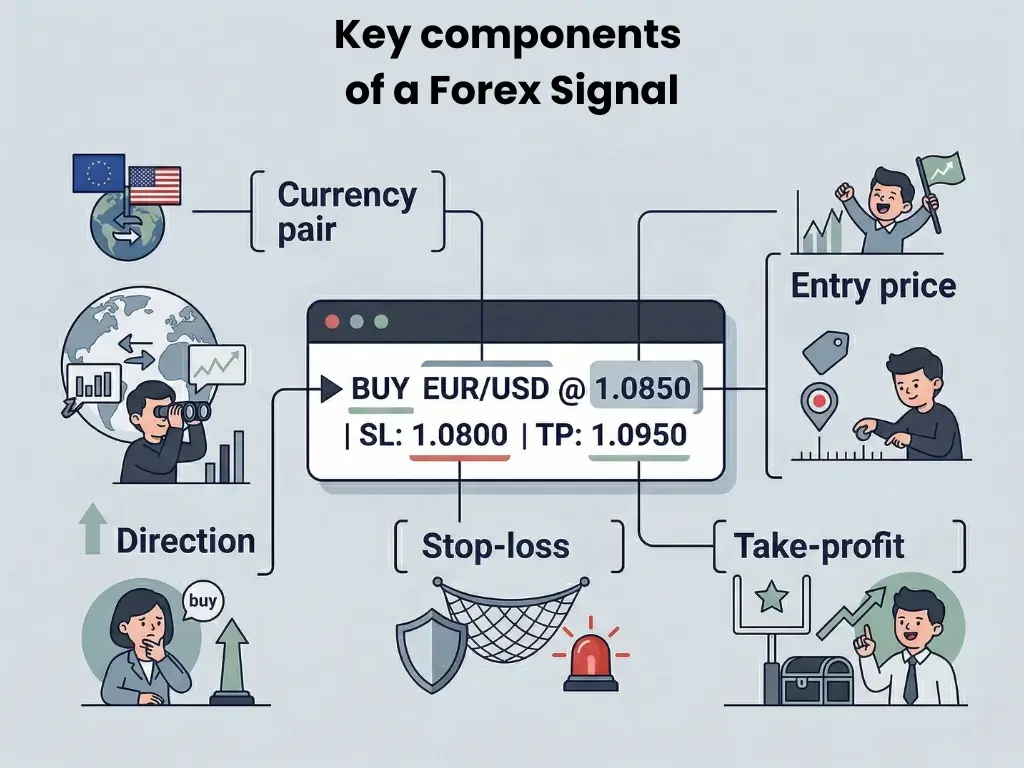
A forex trading signal is a trade alert that highlights a potential opportunity in the market. It may be generated by a human analyst or an automated system, and usually includes key details such as:
- Currency pair: The specific pair being referenced, such as EUR/USD or GBP/JPY.
- Direction: Whether the signal suggests a long (buy) or short (sell) position.
- Entry price: The price level at which the suggested trade would be opened.
- Stop-loss (SL): A price level at which the trade would be closed to limit potential losses if the market moves against the position.
- Take-profit (TP): A target price level at which the trade might be closed if it moves in the anticipated direction.
For example, a signal might appear as: BUY EUR/USD @ 1.0850 | SL: 1.0800 | TP: 1.0950
However, any signal should be treated as a reference point rather than a certainty, as all trading involves risk.
Difference Between Manual vs. Automated Signals
Manual signals are produced by human analysts who apply technical analysis, fundamental analysis, or a combination of both. Quality and consistency depend heavily on the analyst’s methodology and experience.
Automated signals are generated by algorithms, often called expert advisors (EAs), that scan market data using pre-set rules. They can process information quickly and reduce emotional bias, but they still require monitoring and may struggle during sudden news events or unusual market conditions.
Neither approach is inherently superior. Both carry risk, and past performance is not a reliable indicator of future results.
Free vs. Paid Forex Trading Signals
Forex signals are available on both a free and paid basis. Cost alone is not a reliable indicator of quality.
| Feature | Free Signals | Paid Signals |
| Cost | No direct charge | Monthly subscription or one-off fee |
| Transparency | Often limited | Varies; reputable providers publish track records |
| Signal frequency | May be limited or inconsistent | Typically more regular |
| Analysis depth | Usually basic | Generally more detailed |
| Best suited for | Traders exploring how signals work | Traders who have assessed a provider’s methodology |
Table 1: A comparison of free and paid forex signal services
Why Free Signal Services Exist
Free signal services are offered for a range of reasons. Some are used as a lead-generation tool by brokers or third-party platforms. Others are community-driven, shared by traders within forums or messaging groups.
Approaching free signal sources should be assessed as carefully as paid ones. Being free does not remove the risks, and some providers may not clearly disclose their method, track record, or potential conflicts of interest.
How Forex Signals Are Delivered
Forex signals are distributed through several channels:
- Dedicated signal apps: Platforms built specifically for signal delivery, often with performance tracking features.
- Telegram channels and groups: A widely used method due to ease of setup and broad reach. Signal providers may operate public or private channels where alerts are posted in real time.
- Email alerts: Used by some providers for non-time-sensitive signals or daily summaries.
- SMS: Less common, but still used by traders who prefer mobile-first delivery.
- Broker platforms: Some brokers integrate third-party signal tools directly into their trading platforms.
The delivery channel does not determine the quality of a signal. Each should be evaluated on its own merits.
What Can Go Wrong with Forex Signals?
Forex signals can be a useful reference point, but they carry a range of risks that traders should understand before incorporating them into their approach. Market conditions, signal quality, and execution all introduce variables that can affect the outcome of any signal-based trade.
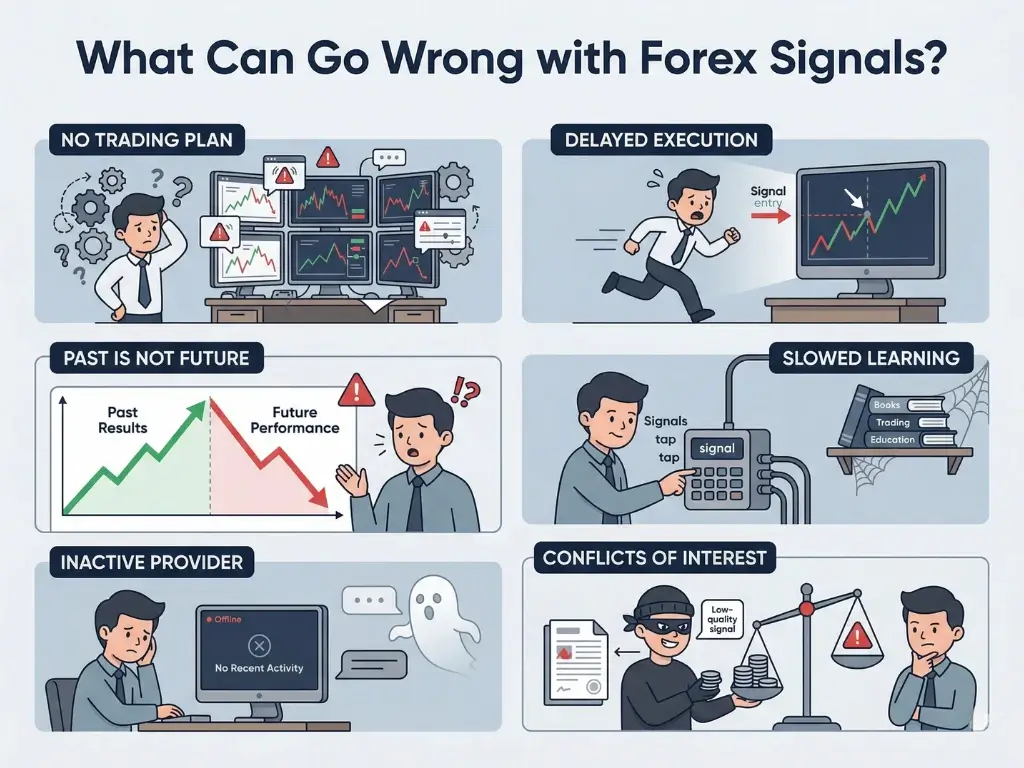
Signals should generally be treated as one input within a broader trading approach, not as a complete strategy on their own.
How to Verify a Signal Provider’s Track Record
One of the most important steps before following any signal provider is independently verifying their performance history. A provider that cannot or will not share verifiable results warrants caution.
Using Third-Party Verification Tools
Performance verification platforms allow traders to review independently tracked trading history — including win rates, average return per trade, maximum drawdown, and the number of trades completed over time. When reviewing any track record, consider:
- Sample size: A meaningful record should cover enough trades over a reasonable period, not just a short run of recent wins.
- Drawdown: This shows how far performance fell from its peak before recovering. A high drawdown may point to greater risk than the win rate suggests.
- Consistency: Steadier results over time can be more useful than brief periods of strong performance.
- Risk-to-reward: A high win rate can still lead to poor outcomes if losing trades are much larger than winning ones.
Common Red Flags to Look Out For
Performance data is only one part of the picture. Traders may also want to be cautious of providers that show signs such as:
- Guaranteed accuracy claims: No provider can guarantee results or predict market movements with certainty.
- No verifiable track record: If results cannot be independently checked, it becomes harder to assess the service fairly.
- Pressure tactics: Urgent phrases such as ‘limited spots’ or ‘join now before the market opens’ may be used to push rushed decisions.
- Large upfront payments without transparency: Reliable providers are usually willing to explain their method and share results before asking for a major financial commitment.
- Unverifiable operators: Providers with unclear backgrounds, limited transparency, or no visible oversight may warrant closer scrutiny.
These points are general indicators rather than fixed rules. Traders are encouraged to do their own research before acting on any signal or subscribing to a service.
How Forex Signals Fit Into Your Trading Approach
Forex trading signals can be useful, but they are not a strategy by themselves. They work best as one part of a broader approach that also considers market context, risk management, and review.
Before using a signal, it is important to understand what it is based on, how it affects your overall exposure, and whether it aligns with your market view.
Platforms such as MetaTrader 4 (MT4) and MetaTrader 5 (MT5), available through Vantage for forex CFD trading, provide charting tools, technical indicators, and order management features that can support this process.
Frequently Asked Questions
What Is a Forex Trading Signal?
A forex trading signal is an alert that suggests a potential trading opportunity on a currency pair. It typically includes an entry price, a stop-loss level, and a take-profit target. Signals can be generated manually by analysts or automatically by algorithms. Acting on any signal involves risk, and losses are always possible.
What Is a Forex Trading Signal?
A forex trading signal is an alert that suggests a potential trading opportunity on a currency pair. It typically includes an entry price, a stop-loss level, and a take-profit target. Signals can be generated manually by analysts or automatically by algorithms. Acting on any signal involves risk, and losses are always possible.
Are Free Forex Signals Reliable?
Free forex signals vary widely in quality. Some are produced by experienced analysts and shared openly; others may lack transparency around methodology or track record. The absence of a cost does not indicate reliability. Any signal — free or paid — should be evaluated on the basis of independently verifiable performance data and clear risk disclosure.
Can Forex Signals Be 100% Accurate?
No. There is no signal service that can reliably predict market movements with certainty. The forex market is influenced by economic data releases, geopolitical events, and shifts in market sentiment that no algorithm or analyst can fully anticipate. Providers claiming 100% accuracy should be approached with significant caution.
What Is the Difference Between Manual and Automated Signals?
Manual signals are produced by human analysts using technical or fundamental analysis. Automated signals are generated by algorithms applying pre-set rules to market data. Manual signals may adapt more readily to unexpected events; automated systems can process information faster and reduce emotional bias. Both types carry risk.
Can Artificial Intelligence Generate Forex Signals?
Some automated signal systems incorporate machine learning or AI-based models to analyse market data. However, AI systems do not have access to live price data, and their output should not be treated as a trading recommendation. Traders should be cautious of services that make broad accuracy claims without disclosing their methodology or providing verifiable track records.
What Should I Look for When Evaluating a Signal Provider?
Key factors include: a verifiable and independently tracked performance history, transparency around methodology, a clear risk-to-reward framework, realistic claims, and the absence of high-pressure tactics. Drawdown statistics are particularly useful, as they provide context beyond win rate alone. Where possible, use third-party verification platforms rather than relying solely on a provider’s own reported figures.